

Mussels Chile
Mussel farming in Chile is a major aquaculture industry, with Mytilus chilensis (Chilean mussel) being the primary species farmed. The industry has grown exponentially over the past two decades, making Chile one of the world’s leading producers and exporters of mussels. In 2024, Chile harvested 404,402 tonnes of mussels, a 1,500% increase since 2000, and ranks second in aquaculture production after Atlantic salmon.
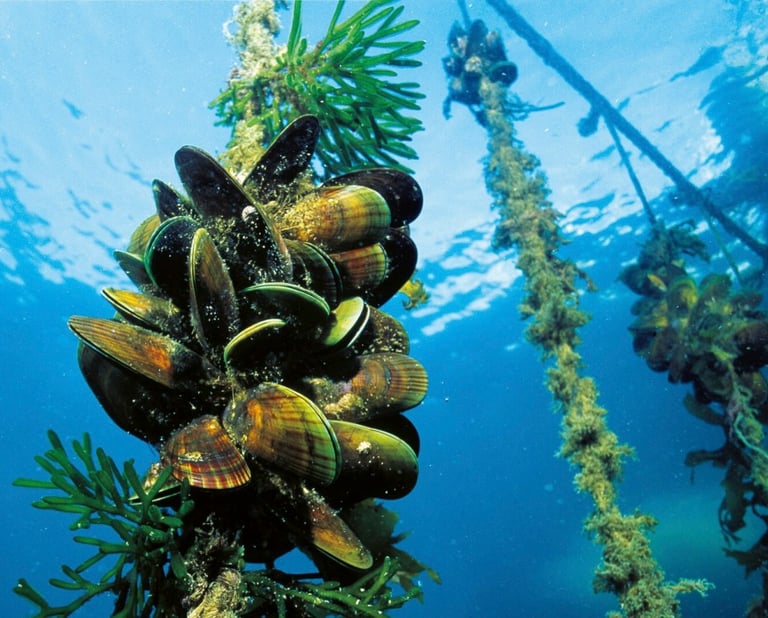
The industry is highly concentrated in the Los Lagos Region, particularly in the Chiloé inner sea (between 41°30″ S and 43°30″ S), where 99% of commercial production occurs. Farms use suspended long-line systems, with vertical lines attached to a main rope held by floats and anchored to the seabed. This method allows for efficient grow-out over 12–24 months.
While the sector has expanded rapidly, challenges remain, especially in seed (spat) production, which still relies heavily on wild collection rather than hatchery-based systems. Only one hatchery, the Chinquihue Foundation, produces mussel seed in Chile, with a focus on supporting small-scale and low-income fishers. Efforts are underway to develop cost-effective land-based hatcheries and improve genetic selection for traits like growth rate and toxin resistance.
Despite these challenges, the industry is environmentally sustainable—mussels are filter feeders that improve water quality and sequester carbon. They are also economically vital, generating 17,000 jobs and an estimated $289.99 million in annual revenue. Exports primarily go to Spain, Russia, the USA, Italy, and France, with a growing push to build a national brand for Chilean mussels to compete in premium, certified markets.
The future of the industry depends on innovation, better coordination across regulatory bodies, and climate resilience, particularly in response to increasing threats from harmful algal blooms and climate change.

Although FishFarmSolutions.com does not endorse third-party services, all links are reviewed for relevance and operational status. Verified listings meet our basic criteria for transparency and contactability.